
Why Nail Psoriasis Is So Often Overlooked
In many clinics, the focus is on treating skin plaques - and nail symptoms get left behind. But up to 80 - 90% of people with psoriasis will have nail involvement at some point.
Nails grow slowly, and the symptoms - like pitting, lifting, or thickening - don’t always respond to the same creams used on elbows or knees. As a result, even if your skin is getting better, your nails may keep worsening unless you’re given a specific plan.
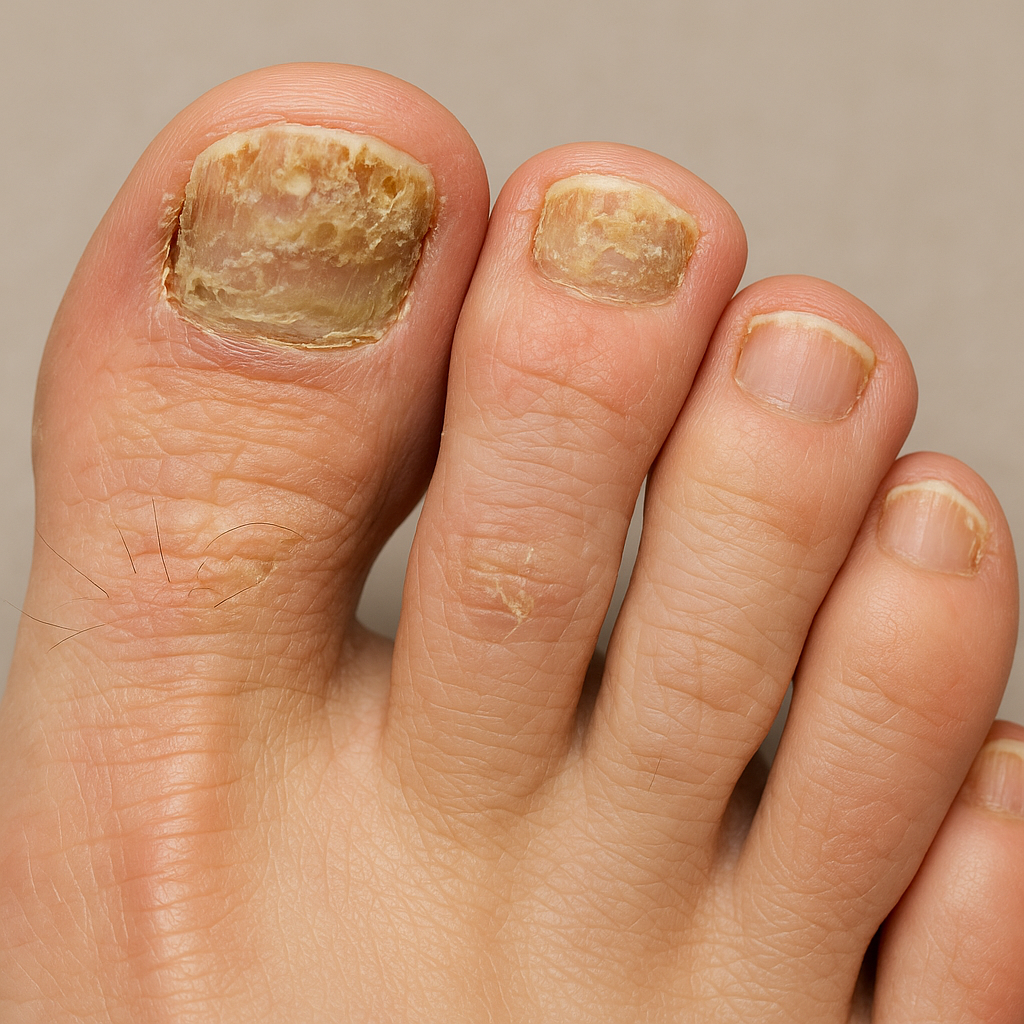
To make things more complicated, nail psoriasis can look like other conditions. Many people are misdiagnosed with fungal infections and end up using antifungal treatments that don't help. Some go years without a clear answer.
You can Book your Psoriasis Nail Consultation to obtain a prescription treatment for nail psoriasis.
The Problem with “One-Size-Fits-All” Advice
[Embedded image: Healthy vs Matrix-type Nail Disease]
Even when nail psoriasis is recognized, treatment can be vague or incorrect. You might have been told to just apply a steroid cream and wait. But without clear instructions - what part of the nail to treat, how often, or how long - most patients don’t get better.
Why is this a problem?
- Wrong medication for the wrong area: Matrix changes (like pitting) need one type of treatment. Nail bed changes (like lifting or discolouration) need another.
- Overuse of strong steroids: Without proper guidance, some people use Clobetasol for months, risking skin thinning or side effects.
- No maintenance plan: Flares are treated but there's no long-term prevention, leading to constant relapses.
This lack of structure is frustrating - but it doesn’t mean your case is hopeless.
What Effective Nail Psoriasis Treatment Looks Like
Here’s the truth: nail psoriasis can be managed - but it takes the right product, used in the right way, for the right duration.
We review evidence-based treatment plans that are customized depending on which part of the nail is affected.
Two Types of Nail Psoriasis - and Why the Treatments Are Different
- To make sense of nail psoriasis and its treatments, it helps to know the three key parts of a nail - cuticle, matrix, and nail bed - because each can react differently when inflamed
- Cuticle
- The thin strip of skin you see at the base of your nail. It seals the gap between the skin and the nail plate, protecting the area where new nail starts to grow.
- Nail Matrix
- A small, hidden “growth zone” just under the cuticle. Cells here build the nail plate.
- Nail Bed
- The layer of skin directly beneath the hard nail plate, stretching from the cuticle to the fingertip. It anchors the nail in place.
Psoriasis can inflame either one:
- Nail matrix (under the cuticle)
What happens: Psoriasis speeds-up cell growth in this tiny “factory,” so the nail plate comes out uneven. That causes pitting (little dents), white spots, thick or crumbly nails, and sometimes a ragged cuticle.
[Embedded image: Psoriasis Nail-Matrix]
Why treatment differs: The matrix sits deep under skin. Ointments must reach it from above the cuticle, or medication has to be injected right around the nail fold. Simply painting cream on top of the nail won’t reach the problem.
- Nail bed (skin under the nail plate)
What happens: Inflammation loosens the bond between nail and skin. The nail lifts (onycholysis), yellow “oil-drop” patches appear, and chalky debris builds up underneath.
[Embedded image: Nail Bed]
Why treatment differs: Because the bed is under the plate, drops or solutions have to flow beneath the free edge, or foams that seep into small gaps are used. Medicines aimed at the matrix won’t help lifting or thick debris.
The nail matrix is like the mattress - when it gets uneven, the nail surface turns bumpy, so creams need to go around the cuticle to smooth it out.
The nail bed is the bed frame - if it’s irritated, the nail lifts like a loose mattress, so drops or foams must slide under the nail edge to steady things.
Flare Treatment (Short-Term)
Flare treatment is chosen based on where the psoriasis is showing up - in the nail matrix (the base of the nail, under the cuticle) or in the nail bed (under the nail plate).
These are the options we use, based on the most current clinical practices. You can schedule a messaging chat with one of our physicians to clarify what treatment is appropriate for you. Importantly, no treatment we discuss here should be pursued before consulting with a healthcare provider, as this information is for educational purposes only.
How to Match Treatment to Your Type of Nail Psoriasis
Cuticle trouble - pitting, crumbling, ragged rim (Matrix-type)
[Embedded image: Before and After - Matrix Flare - Treated]
- Step 1 - Knock down the flare
- Put clobetasol scalp solution on the cuticle rim once every night for 4 weeks.
- Keep the liquid only on the thin skin hugging the nail, not on the hard nail or fingertip.
- Step 2 - Switch to gentle upkeep
- After those 4 weeks, change to Protopic® (0.1% Tacrolimus) ointment twice a day.
- Massage the same rim of skin and the skinny folds on each side.
- Stay on this for up to 12 weeks
Why this works: Both medicines reach the hidden matrix right under the cuticle, calming the “growth zone” so new nail grows out smooth.
Nail lifting, yellow “oil-drop” stain, chalky debris under the tip (Bed-type)
[Embedded image: Nail Bed Psoriasis]
- Step 1 - Target the space under the nail
- At bedtime, tilt the finger and let one drop of clobetasol solution slide into the gap beneath the nail tip.
- Cover the finger or toe with a small waterproof bandage or finger-cot so the liquid stays put.
- Continue every night (or every other night if skin gets sore) for up to 4 weeks.
Why this works: The drop flows along the nail-bed, shrinking the inflammation that loosened the nail.
Both the nail surface and nearby skin look red or thick
One-step plan
- Spray Enstilar® foam (calcipotriol + low-dose steroid) onto a fingertip.
- Rub it over the entire nail plate and the thin rolls of skin on each side once nightly.
- Use the foam for up to 4 weeks
Why this works: The foam seeps through tiny spaces on the nail plate to reach shallow nail-bed inflammation, while also calming redness in the surrounding skin folds.
Need a steroid-free approach for a cuticle flare
Protopic® only
- Apply Protopic® (0.1 % tacrolimus) ointment to the cuticle and side folds twice a day.
- Useful for sensitive skin or if you must avoid steroids
- Typical course: 12 weeks.
Tazarotene (retinoid) 0.045 % lotion
Although this medicine is used as an acne treatment - so it may sound like an odd fit for nail care - research shows it can smooth out matrix-type pits with zero risk of thinning the surrounding skin.
- How to use: Brush a thin film over the cuticle rim once nightly. If stinging occurs, alternate nights or add a plain moisturizer first.
- Use it for 12 weeks then switch to maintenance treatment.
- Why it works: Retinoids slow the over-rapid cell growth in the nail matrix and have mild anti-inflammatory effects.
What to Expect
- First signs of change: 6 - 12 weeks (new, smoother nail starts to emerge).
- Full grow-out: 4 - 6 months for fingernails, even longer for toes.
- If nothing improves after 12 weeks, or skin becomes thin or irritated, check back with your healthcare provider to adjust the plan.
Remember: we pick the single plan that matches your nail problem - you don’t need to layer all the products at the same time.
Why Maintenance Matters
Knocking down a flare is only half the job. Because fingernails grow only 2 - 3 mm per month (and toenails even slower), it takes about 6 - 12 weeks before the fresh, healthy nail that formed under maintenance therapy even reaches the visible edge, and 4 - 6 months to see the full length grow out smooth and clear. If you stop treatment right after a flare settles, the hidden inflammation can reignite, and the pits, lifting, or yellow patches come back just as the new nail emerges. A light, steady maintenance routine keeps that inflammation quiet the whole time, protects the progress you’ve made, and reduces how often you need strong steroids. Think of it as daily brushing for your nails: a small habit that locks in the bigger gains you worked so hard to achieve.
Maintenance Made Simple - Where to Put Each Medicine
Once your flare improves, we don’t stop treatment - we adjust it to keep your nails from getting worse again.
Each product should be swept over the whole nail: cuticle, surface, and - if you can - under the tip.
Steroid-Free Choices
- Medicine: Tacrolimus 0.1% (Protopic® ointment)
- How often: 2-3 times a week
- How to use: Dot a pea-sized amount on the cuticle rim, smear it across the nail plate, then wipe any extra along the underside of the tip. Let it soak in - no bandage needed.
- Medicine: Calcipotriol 0.005% (Dovonex® ointment - pure vitamin D)
- How often: Three nights a week (for example Tue, Thu, Sat)
- How to use: Brush a thin film around the cuticle and over the nail surface. Do not cover; allow it to air-dry.
Steroid Choices
- Medicine: Enstilar® foam (calcipotriol + betamethasone)
- How often: Twice a week
- How to use: Shake the can, spray a small puff onto a fingertip, and rub it over the cuticle, nail plate, side folds, and any visible lifting.
- Medicine: Clobetasol 0.05% solution (strong-steroid “rescue”)
- How often: 1-2 times a week
- How to use: Tilt the finger, let one drop flow across the cuticle, over the nail, and under the free edge; cover overnight with a finger-cot or small bandage.
What Not to Do When Treating Nail Psoriasis
- Don’t “double-dip” products. Layering two strong steroids, or a steroid plus a retinoid, can irritate skin instead of helping.
- Don’t file pits or thick debris too aggressively. Rough filing can trigger the Koebner effect (new psoriasis where the skin is injured).
- Don’t share clippers or files. Psoriasis-weakened nails pick up fungus and bacteria more easily.
- Don’t soak fingers in undiluted vinegar, bleach, or “home cures.” These dry the skin and slow healing.
Watch for Skin Atrophy (Thinning)
Potent steroids like Clobetasol do a great job knocking down a flare - but over time they can thin skin, especially around the cuticle.
Early warning signs
- Shiny, almost see-through skin at the cuticle
- Tiny red or purple blood vessels becoming visible
- Skin that wrinkles or tears with minor friction
- A slight “paper-like” feel when you press on it
What to do
- Stop the strong steroid and switch to a non-steroid (Protopic® or vitamin-D ointment).
- Moisturize twice a day with a fragrance-free cream.
- Tell your doctor!
Fungal Nail Infection - Common in Psoriasis
- Overlap is real. Up to one-third of people with nail psoriasis also have a fungal infection (onychomycosis).
- Why it matters. Fungus makes nails thicker, yellower, and more brittle - changes that can mask or worsen psoriasis.
- When to suspect fungus
- Only one or two nails are thick while the others show classic pits.
- Powdery debris smells musty when you trim.
- Oral or topical psoriasis medicine helped the skin but not the nail.
- Next step. You can request fungal nail testing through our site, or your doctor under Our Medical Dermatology Page. If fungus is confirmed, we provide a medicated lacquer (Jublia) to use once daily for 48-72 weeks.
Watch for Paronychia (Nail-Fold Infection)
Sometimes psoriasis-damaged skin around the nail lets bacteria slip in, causing paronychia - a painful, swollen nail fold. Knowing the warning signs helps you act early and avoid bigger problems.
[Embedded image: Paronychia]
Early signs (treat right away)
- Red, puffy rim of skin next to the nail
- Throbbing discomfort when you touch it
- Clear or yellow fluid seeping from a small crack
Home care as soon as you notice:
- Soak the finger or toe in warm, soapy water 5–10 minutes, twice a day.
- Pat dry, then apply a thin layer of mupirocin 2 % ointment (a prescription antibiotic cream) three times daily for 5 days or polysporin (if you don't have a prescription).
Urgent signs (see a doctor for possible drainage or oral antibiotics)
- A visible pocket of pus under the swollen skin
- Spreading redness more than 5 mm beyond the nail fold
- Fever or chills (highly unlikely but possible)
- Pain so intense it wakes you at night
What a doctor may do in this situation:
- Gently lance or drain the pus to relieve pressure.
- Prescribe an oral antibiotic such as Cephalexin (Keflex) for 7 days if the infection is moderate or spreading, or simply Mupirocin 2% ointment.
Take-Home Summary
- Medication choices come in two broad buckets
- Steroid-based (e.g., clobetasol drops, Enstilar® foam) - fast at shrinking flares but time-limited to avoid skin thinning.
- Steroid-free (e.g., Protopic® ointment, calcipotriol vitamin-D ointment) - slower to start, but gentler for long-term maintenance.
- Key tips for success
- Match the medicine to the problem spot (matrix vs. bed) rather than using everything at once.
- Follow the clock: nightly or twice-weekly dosing works only if it’s consistent.
- Watch for red flags like new pain, pus, or shiny paper-thin skin - those signals mean it’s time for a check-in.
- Long-term control
- Protopic® (tacrolimus 0.1 %) is an excellent steroid-free choice for keeping cuticle and side-fold inflammation quiet once a flare has settled.
Use it two to three times a week indefinitely without the risk of skin atrophy that comes with strong steroids. - For stubborn lifting or thick debris, short “rescue” bursts of clobetasol drops can be layered on, then tapered back to Protopic or vitamin-D alone.
- Protopic® (tacrolimus 0.1 %) is an excellent steroid-free choice for keeping cuticle and side-fold inflammation quiet once a flare has settled.
Bottom line: Clear nails come from pairing the right drug with the right spot, respecting steroid limits, and leaning on steroid-free options - especially Protopic® - for steady, long-term protection.
Book your Psoriasis Nail Consultation